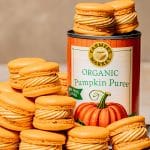
Pumpkin Spice Macarons
Equipment
- kitchen scale
- electric mixer
- flat baking sheet
- piping bags
- round piping tips
- macaron silicone baking mat
Ingredients
For the Macaron Shells:
- 130 g powdered sugar
- 120 g almond flour
- 105 g egg whites about 3
- 100 g granulated sugar
- 1 tsp vanilla bean paste
- 10 drops orange food gel coloring optional
For the Swiss Meringue Buttercream:
- 150 g reduced pumpkin puree start with 200g canned pumpkin puree
- 72 g egg whites about 2
- 150 g granulated sugar
- 170 g unsalted butter room temp but on the cooler side
- 1 tsp pumpkin pie spice
- ½ tsp vanilla bean paste
- 5 drops orange food gel coloring optional
Instructions
For the Macaron Shells:
- Place macaron baking mats on two baking sheets and add parchment on top of each. Alternatively make your own template - see notes.
- In a medium bowl, sift the powdered sugar and almond flour twice.
- Next, heat the egg whites and granulated sugar over a double boiler until the sugar has dissolved or until the temperature is about 120 degrees F.
- Transfer the egg white mixture to a large bowl or a bowl of a stand mixer fitted with a whisk attachment. Whisk until the meringue reaches soft peaks. At this point, you can add the vanilla paste and food coloring. Continue whisking the meringue until stiff peaks form.
- Start the macaronage by folding in ⅓ of the dry ingredients. Mix carefully with a silicone spatula by scraping around the sides of the bowl, then through the middle of the batter. Do this a few times until it is mostly combined.
- Add the remainder of the dry ingredients, folding with the same gentle method. Once the dry ingredients are fully incorporated, begin spreading the batter along the sides of the bowl to deflate it slightly. I find that this mixing method helps prevent the shells from baking up hollow. Continue scraping around the sides of the bowl and through the middle. The mixture is ready when you can draw several figure eights without the batter breaking.
- Transfer the mixture to a piping bag with a small round piping tip (I used Ateco 802).
- With the macaron baking mat placed under the parchment paper on the baking sheet, pipe at a perpendicular angle to fill in the smaller circles. Carefully remove the baking mat and tap the baking sheet on the counter a few times in order to release any air bubbles. It also helps to bang on the bottom of the baking sheet with your hand.
- Let the macarons rest for about 30-40 minutes, or until they are dry and no batter comes away when you touch them.
- Meanwhile, preheat the oven to 300 degrees F. Bake the macarons for about 12-14 minutes. Allow to cool completely before peeling them off the parchment paper.
For the Swiss Meringue Buttercream:
- Reduce the pumpkin puree by adding 200g of pumpkin to a small saucepan and heat over medium heat, stirring frequently for about 5 minutes. Weigh out 150g in a small bowl. Set aside to cool.
- In a double boiler, heat the egg whites and sugar, whisking frequently until it reaches 160 degrees F.
- Transfer the egg white mixture into a bowl of a stand mixer with a whisk attachment. Whisk on high speed until stiff peaks form. Turn the mixer down to low speed, and wait until the meringue cools down below 85 degrees F.
- Cut the butter into cubes and add to the meringue one piece at a time, allowing each piece to fully incorporate before adding the next. Once all of the butter is added, it may look curdled, but keep beating for a few more minutes and it will come together.
- Once the buttercream has mostly come together, change the whisk attachment to the paddle and keep mixing on low speed until homogenous and smooth.
- Add the reduced pumpkin, pumpkin pie spice, vanilla bean paste, and food coloring, mixing until fully combined. If your buttercream splits from the butter being too cold, microwave the whole bowl in 15 second increments, mixing in between, until it comes back together.
For Assembly:
- Transfer the buttercream to a piping bag fitted with a star tip (I used Ateco 864).
- Pair the macaron shells up and pipe the buttercream onto the bottom shell, then place the paired shell on top, pressing down slightly to ensure they stick together.
Notes
- How to make your own macaron template: Prepare a macaron template by using a large piping tip or small round cookie cutter of about 1 ½″ in size to trace circles about 2 inches a apart on one sheet of parchment paper. You will place this under another piece of parchment paper when ready to pipe the macaron shells.
- Make the macarons ahead of time: The flavor of macaron shells develops more by the second day, so I recommend making them the day before and chilling them overnight, then serve the next day.
- Freeze the macarons to peel them off: If you have trouble peeling the macarons off of the parchment once they have cooled, pop them into the freezer for a few minutes and they should come off easily.
- Wait until the meringue is cool before adding butter: For the buttercream – DO NOT add the butter to the swiss meringue until it has cooled down to below 85 degrees F. I have made the mistake of adding it too soon, and the meringue ended up melting the butter and turned the whole thing into a soupy mess. If your meringue has reached stiff peaks before it is cool enough, turn the mixer down to low speed and keep it there until it reaches the right temperature.
- Macarons get even better with time! Macarons will last for a few days at room temperature and up to a week in the fridge. I prefer to store them in the fridge not only so they will last longer, but also because I find that they taste even better cold